Tuesday, April 21, 2020

How COVID-19 is good for golf

How can COVID-19 be good for anything?  

It seems like life as we once knew has changed forever, maybe that is true, and maybe some things will be better.  I honestly believe that suffering transforms us more than any other feeling if we do it right.  The COVID-19 situation offers us an opportunity to pause in time and really consider our situation and how current reality has come to be. If you really love golf, read this in a spot where you can let some things marinate for some time, not rushing through it like we do most things, but to take some time to pause when a sentence makes you think.

Historic clubs have established identity, here stands
the second purpose-built clubhouse in the country.
 In the last 15 years I've heard it all...Golf is Dead, Golf is Back, Golf is Dying.  The truth is that golf has been limping along.  The affluent clubs and destinations will always do well,
we can't determine the state of golf by the fact that Pebble Beach is maintaining.  When I speak of golf in this post, I speak to the average...to the masses.

Golf's identity crisis


What is really interesting about the golf industry is the identity crisis at most facilities.  The best facilities are the ones who know what they are and attract their customers solely based on that principle.   The historic clubs that have stood the test of time seem to have made things simple, not more complicated.   The "simpleness" is what conveys their awesomeness.  They seem to have a very simple and elegant definition about themselves which makes them above judgement or scrutiny.

Simple is classic
Knowing what you are allows you to attract and maintain customers right now and that is critical.  If I attempt to attract customers with the promise that I will be the greatest club in the area with some grand mission statement, I am setting everyone up for disappointment.  Attracting customers based on some future self, even if it is loosely defined with some grand mission statement, allows each customer to define what that is on their own, and that is a recipe for failure.

Understanding what you are requires real honesty and a humble nature.  Rules to determining who you are....... Number 1) Entities can't be everything to everybody and  2) Entities can't worry about what some other facility is or isn't when determining who they are.

Golf is a sport.  

Sports have all kinds of cultural and societal impacts which will be considered if a facility wants to be golf-centric.  Golf facilities should be about golf first, otherwise its not a golf facility.  I don't know what exactly it would be, but we have them.....everywhere.  I guess they would be "whatever their focus is- facility" and golf place.  Like...Neighborhood Bar and Grill & Golf Thingamajig.

If a facility is focused on golf I would think that it would focus on one thing.....amateur competition.  It seems like all great golf facilities started there.  When you zero in on the game of golf and amateur competitions, and contemplate what that is, the things that you do well and things you do poorly will appear out of the fog like a lighthouse showing the way to lost ships.

Well run, fair, honest, and open amateur events, will draw more golfers to a place than any fancy buffet or contrived water features could ever.  Open amateur events draw people to the game and demand that such facilities provide people with the opportunity to participate in competition and this gives another layer and focus of what is really important.  Knowing what a facility is allows clarity, purpose, and simplicity.  Golf facilities, that are truly golf facilities, focus on the game.  Focus on what is necessary for the sport and provide just that before moving on to other distractions.

I will note, that there are many social clubs or fraternities that have golf courses as an amenity and that is just fine.....just know what you are and be that.  Prioritize from that high ground that you look out into the world and make sure you are surrounded by the pillars that support that position.  If from that position you decide to make a mission statement, state your focus.....what you are....immediately, so that it is clear to the staff, decision makers, and absolute leaders that "identity" which is theirs to uphold.  Notice it is to uphold, not to become!  That which you say you are is an examination of existence and now, it can be used to prioritize in the moment.  What you state as your mission (some future self) is a foggy quagmire of possibility, subject to the whims of changing absolute leadership, personal agendas, and flimsy fads or trends.

The golf industry should use this time to rid itself of its dysfunctional tendencies.  Lets stop throwing stuff to the wall to see what sticks.  Golf sticks, it is what has stayed.  We need those in absolute leadership to put aside egos, agendas, and personal vendettas.  Golf survives despite the best efforts of these things to derail it.

Modern Architecture has some explaining to do

Taking a hard look


Golf also needs to examine why our 9-hole mom and pops have closed, why we have to pay $60 a round, and must take a cart.  We have to look at the 9-hole facilities that are being built and ask why.....why are we putting forced carries and water features next to greens that are designed for beginners?  Have we lost our minds?  We need a voice of reason.  We need to look at what the over-planting of trees have done to classic architecture and the cost of maintenance.  It is also time to have some serious discussion about modern golf course architecture and what it has done to golf.

If we are to run the golf facility like a business we would determine who our consumer is, deliver what they want, and at a price they are willing to pay.  We can use this time to strip all the unnecessary fromp that puts additional strain on resources.  Golf facilities would be much better off financially with that very simple equation.  If you want to see what the USGA has to say about this, here is a link.

Golf wants to do what its always (actually recently) done, because well.....its just how we've been doing it.  Golf and in some cases pseudo-golfers, recently adopted the stereotypical country club.
The "Bushwood C.C." from the movie "CaddyShack."  Golf was more about silly amenities and entitlement than about the spirit of the game.  We ran with the idea of excess and novelty, and haven't questioned if they were really needed, if they were good for the game, or if we were just trying to keep up with the Jones'.   I say recently, because Old Tom Morris would not run his course(s) like we do.  Golf was run for golf, by golfers.  Old Tom Morris served in all capacities, all focused on the game of golf.  The primary purpose was the game for the sport.  We should put more effort into running quality competitions than on stacking pyramids of balls on maniac hill.

Old Tom Morris at the beverage cart
We ran astray when the facility became about ancillary activities, these activities began assuming the focus and consuming a lions share of resources.  I am not suggesting that all clubs or golf facilities are this way, so save your hate mail.  Clearly some clubs can afford lavish clubhouses and services, and if they are golf facilities, then those amenities were born out of golf.....not created aside from golf.  I am speaking to the clubs that are in the game of financial paycheck to paycheck.  The reality is that there are "golf" facilities who are still trying to figure out how to get more people to come and eat at the golf course instead of figuring out how to satisfy, in a cost effective way, the hunger of those who frequent the property for sport.  

The answer to how the current identity crisis happened is simple.  We built big buildings thinking they would pay for themselves.  Then we hired people to try and sell things in the big building to try and pay for it.  Then we made the person in charge of selling things in the building in charge of the entire facility.  We basically took a baseball team, built a giant hotdog stand, hired a hotdog salesman, and before we were really good at selling hotdogs, we gave him the keys to the whole damn franchise.....Sound nuts?  Think about it.

So, with all that, what can golf do?

Golf facilities should start with asking questions, like.....

Are we committed, first and foremost, to the game of golf, or something else?  What is our commitment to?  (Man cannot serve two masters, priorities will be born out of, not aside from)

If we committed first and foremost to golf, what would that look like?  How would we break the financials out to reflect that?

Golf should look at the parking lot and notice who is there and why.  Do you really have golfers, or men with sticks? (see next question)

What is the quality of our competitions? Why?  Does the quality of our competitors match the quality of our competitions?  (I bet they correlate exactly!!)

How do we encourage the beginner to play?

Is your curbside food service kicking it, how, what?  To whom?  What does this teach us about our offerings?

Why do we need all the ropes and stakes?  Is your facility walkable?  Why not?

Do golf carts/outings/functions bring our facility added value and revenue?

Do golf carts/outings/functions turn our facility into a drunken bonanza?

Do we plant things (flowers, trees, markers, walls) in the earth that we can't afford to take care of?  Hint:  if you took money away from the golf course in the past and the money hasn't returned, but you are considering adding any thing, you probably can't afford it.

An honest time

It is time to have some honest conversations.  These conversations can be entertaining as well.  It has always been amazing the types of conversations that come from golf course facilities.
For example...

Our bent grass fairways have always started about 24 feet from the front of the Tee, how can we reduce the maintenance budget?

We have always had ball washers, what purpose do they really serve?  How do we reduce the maintenance budget?

Members take a stand on the tree issue
We spend how much labor money picking up sticks from trees that we don't have enough money to trim properly?

We are going to spend how much in the fall picking up leaves from said trees?

Said trees require how much more in labor $ to grow decent grass?

We have always had water coolers, how can we increase beverage revenue?

I like flower beds next to the par three tees, why are the bunkers so bad?  How do we reduce the maintenance budget?

We pride ourselves in having any food item possible and service anytime everyday.  How can we create more food and beverage revenue?  (Notice the revenue vs. expense conversation)

I am sure you have some to add, I wish I had the venue for all to participate with some zingers.....

Simple and essential

Golfers stopped managing Golf facilities.  When that happens, golf becomes the ancillary activity and the course, competitions, the sport all suffer.  Ten dollar popcorn and five dollar sodas work at movie theaters, because they were born out of, not aside from the main focus of the theatre.

"Golf" a smart man I know quoted, "has survived two world wars, a couple of depressions, 9-11, and disco....it will survive this."  We have an opportunity in front of us, we can look at our operations and decide what is absolutely necessary.  When we go back to golfing, do we go back to what was absolutely essential for the game, or do we go back to doing what we imagined was absolutely essential?

The simple is maybe how we reach the next generation, life seems cyclical, and COVID-19 may be the catalyst that makes us reassess what essential really means.  In a world full of paradox, maybe golf is that balance, the minimal and simple escape that means so much to the human soul.  Perhaps that is why golf has struggled, we strapped it with all the clutter of our day to day lives and the game no longer offered any escape.  Golf became saddled with our messiness.  Instead of keeping to its core values we have actually suggested changing the rules to fit us and our lifestyles, probably because we had gotten so far away from the roots of the game, that we didn't recognize what it was anymore.  It didn't offer the simple beauty that is the essence of golf.

"Simplicity is the ultimate sophistication"
                              -Leonardo da Vinci

Cheers,
Turf


Tuesday, November 12, 2019

Realistic Expectations,Job Satisfaction, and Operational Standards: A perfect trio

The original post was a result of my observations during 24 months immediately following my retirement from the position of General Manager / Director of Golf Operations in August 2016.  It was a response to my fear that the golf industry will lose many professional and hard working individuals in the near future.  This loss, which will cost the industry billions of dollars, is almost imminent   Think replacements can be hired at no increased cost?  Good Luck!  There is plenty of information out there.  This commentary I believe is pertinent to any industry that has "pretended" not to take operational resources away from a department.  I say pretended because we seem to be in denial that todays dollar is the same as yesterdays.  If we are not increasing budgets, at a minimum, to the percent increase in the cost of goods which supply that operation, then reducing operational standards equally must follow.  For failure to increase a budget, by a minimum of a well thought out percentage, is reducing it.  

Operating to an unobtainable standard is disheartening.  Job satisfaction of a majority of golf course superintendents appears moderate to low at best.  The common attitude at mid-level to low-end golf facilities seems to mirror a beat dog.  But what is striking is that these individuals love what they do! They live for their jobs, they love the people, the nature, the challenge!!  These are good hardworking people that are simply disillusioned.  They once believed they could do a good job, but now it is failure after failure. It is not they they are failing at any given task in front of them, its more of an existential failure. A perceived failure against foggy and unclear goals. Usually people keep goals vague to avoid failure, but this is an example of ensuring it. The failure is primarily as a result of not being able to meet expectations that haven't been defined from the beginning!


So it seems that there exists a disconnect between resources and expectations. As resources have flatlined, expectations have stayed the same. We could do a better job outlining standards and that would alleviate much undue suffering on the behalf of management.  I believe operational standards would improve job satisfaction, help prioritize labor and capital, improve communication, and clarify expectations.

Expectations, as they seem to me, are predictions regarding a future experience.  They seem complicated and possibly influenced by motivations derived from an individuals personality, past experiences, and fantasies of future experiences.  I was reading about expectations and came across something really interesting.  "Expectations are premeditated resentments," repeats John A. Johnson PhD in Psychology Today.  Wow, I never saw expectations in such a damaging light until I read that.  I am not sure what to do with that just yet, I'm kinda processing it.


There seems to be an identity crisis in golf.  Not all clubs or courses are in the process of finding their identity.  There are many clubs that for a variety of reasons are doing well, I feel that is due much to the successful management of customer or member expectations and a clear vision of what they are and what they are not.  The struggle as it pertains to the others is that they are living beyond their means, in some fantasy of what they think they "should be" and without much justification of why.

How did we end up this way? Modern golf facilities are tied tightly to a very historic model. Instead of honestly examining what society wants from us, we stuck to a model that was built during a different era and served a different purpose. Unless we want to try and reinstitute some of those old networking and local business loyalties, we may want to reconsider our function and model ourselves to align with it.


Not too long ago, we experienced something amazing in the golf world, posh facilities for the middle class. For the first time in human history, could the working class have the experience that was once left for only the wealthiest and well-to-do in communities. Country clubs became accessible to people of most socio-economic cultures.  Much of that due to a booming real estate and development market that was positioning itself for catastrophe, but thats a whole other conversation. Anyhow..........

Country clubs were popping up like starbucks, and everyone was jamming.  Flower Beds, grand structures, lavish locker rooms, high end food and drink, man...things were good.  We had money to spend and we could write off dues.  Then, with the passing of the Clinton tax bill, that changed, but all was ok, a majority was making enough money that this wasn't going to affect much just yet.

March 10, 2008 the Dow Jones drops 20%, and things changed.  In the aftermath of the boom, we were left reeling.  Many dropped their club memberships, some changed their membership status.  Whatever the case, "do more with less" became the favorite saying at club board meetings.  Not sure they could afford club dues and feeling pressure, some seemed to look for reasons to be dissatisfied, others noticed diminished amenities or perks that they once enjoyed but now went without due to a reduction in club membership dues.

Those that were left holding the tab (paying dues) at the club table seemed to have been told that dues would stay the same and nothing would change.  We seemed frozen by fear that telling the truth would result in losing what members remained.  What seems self evident is that a facility cannot function on less revenue and perform to the same standard.  I am not suggesting that people are not "justified" in the disappointment of missed expectations.  I think that is part of being human.  

The part that I think is missing is the contraction that would organically take place if nature were to take over.  If we were to build these places again, would they be as complicated and expensive?  To really consider what this would mean, I think looking at how clubs became what they are today is important to understand what the need to become tomorrow.  What certain clubs will become in the future may be different from what they were.  This means eliminations or reductions of certain services and the addition of others.

Lets consider a brief history........A group of people get together and they decide they want to play golf. How much will it cost and are they willing to pay for that privilege?  If the answer was yes, farm land is purchased, usually near the train, with a house to change clothes, awesome.  Maybe then we need a person to clean the house, tend to things a bit, all in favor?  Great.  Next we decide it would be nice to have lemonade on the porch after, we may need electricity....another vote.  My point is, clubs became what people were willing to divide up and pay for; not a build it and see, they were indeed a pure creation.

Fast forward and we have a perception of what the country clubs are.  What clubs are, is not based so much on what we want them to be to us as much as what they have historically been.  When what people want or use the club for changes, a contraction of sorts should logically follow.  The available resources are pooled and they are allocated to the new want or use.  We have to prioritize and focus on what is of the most value and let go of those things that are of little value and importance.  When budgets flatline and the cost of goods and labor increases, something has to give.  Are we having those difficult discussions of what operationally needs to change?  And by change, I mean go away or reduce!

Why is change so difficult for us?  The difficulty lies in the execution of the cessation of an amenity.  People are loss adversed, which means that we would rather not lose, than to acquire the equivalent gain.  The emotional cost associated with loss is much greater than the gain of equal amounts.  The taking of things away, even menu items, really freaks people out and all types of catastrophes are imagined.  Take for example facilities where fine dining is the attempt by the food and beverage department.  In order to provide the service associated with fine dining, food minimums were put in place to ensure the revenue was sufficient.  Food and Beverage minimums are contentious subjects at many meetings, yet facilities didn't seem to want to take the necessary steps to eliminate or reduce the minimums, you see, the minimums are only necessary to provide a "type" of service.  Any perceived reduction in service would be viewed as a loss, even though the reality may be a better experience overall.  The corner gas station does an ok job feeding people and getting them a cold drink and you don't have to spend a certain amount if you want to get gas.

The real trick to job satisfaction seems to include the creation of realistic expectations.  I've read many mission statements that include ridiculousness such as "consistently exceeding customer or member expectations."  That seems to be pure rubbish and is only meant to deflate hard working individuals.  Its no wonder that employees feel dejected and unappreciated, they can't possibly be considered a high performer without sacrificing their personal life by working oneself to death.  One cannot exceed expectations without creating through the process a new higher standard, especially when you have a reoccurring customer as in our industry.  To exceed expectations every time is just not possible because the expectations will increase beyond what we are capable of doing.  One doesn't walk away from a great experience expecting less next time, it just doesn't work that way.

If we care about our employees and want healthy working environments, we are left with the question of how to encourage realistic expectations.  I believe establishing written operational standards that are based on fact is one of the greatest ways to help achieve these expectations.  Lets take the grounds department as an example.

The reduction of labor, chemicals, capital expenditures and overtime, are all things that impact the product that a golf course superintendent can consistently provide.  Establishing operational standards based on the current resources that are realistic and include things like the difficult labor market, are essential to raising job satisfaction scores in golf.  The labor market is tough and turnover is high.  High turnover means more training hours, more money, less productivity and less efficiency.  What your labor dollar provided yesterday is not today.  Knowing how often you can mow rough with the given equipment of a certain age is important.  Most facilities only maintain enough equipment to mow all rough twice per week.  When a property receives 5 inches of rain in five days, and the directive is no overtime, all involved understand and can feel good that they are doing the best they can with what they have to work with.

There are some essential things to keep in mind when creating standards.  When considering standards we have to be realistic regarding labor.  Labor is never 100% efficient and the work is not carried out in the most productive manner.  People stop to talk to other people, they get distracted, they make mistakes and have to go back to a previous task.  Putting a manger in a position to treat people like slaves because the expectation is that labor will perform at 100% all the time is unfair.  Maintenance standards are achieved by tasks carried out by human beings and they need to be allowed to behave like humans if realistic expectations are the goal.   Wages also need to be considered.  Labor purchased at $8.50 an hour is not the same as labor at $17.00 an hour.  If you can't afford high quality conscientious labor, throw the ball washers away......actually, never mind just throw the damn ball washers away.

Written standards aid in equipment assessment 
It is also important to understand your equipment situation when writing standards.  If the bunker raking machine is breaking down and takes four hours in repair for ever hour it is running, well you may not be able to get them done four times per week.  In fact, you may want to just consider a bunker a hazard and allow life to happen.  To the previous point, writing standards can help in making capital purchase decisions and can also aid in discussions considering things like intermediate rough cuts or out of play areas.  The working environment can also be addressed in these documents.  Unless the facility janitor visits the maintenance buildings, then time to make a clean healthy working environment needs to be allotted.  The environment that people work out of can affect their mood and motivation.  Clean, well lit areas are often overlooked in the grounds departments.  I will refrain from addressing the impact of lighting on mood and productivity out of respect for brevity, suffice it to say I think a visit to the maintenance facility would be something.

Written operational standards establish priorities and remove any guesswork.  Without agreed upon priorities, the individual tasked with the responsibility of stewarding a golf course feels an enormous pressure to complete everything.  There are an infinite number of tasks to complete on a golf course.  On any given day, everywhere a superintendent looks, you can see tasks that have been left undone.  Any good superintendent will engage in the exercise of firing themselves every day, and when things are left with a sense of incompletion, it is difficult to feel good about calling it a day.  I always told my Green Committee that they could fire me at any time and to any dismay, I would invite them to ride around with me....."I will show you a hundred reasons."  To that end and now speaking to the frustrated overworked individual.....if not for your decision makers, do this for yourself, so that you can go home at the end of a working day...not at night, at the end of a typical workday and feel good that you are doing the best you can with the resources given unto you, and go home....and enjoy your family and friends.  We go around this rock on time, and your family and friends will be the ones who miss you the most.

Do less with less, or more with more, more with less is a fairytale,

Turf


Wednesday, January 10, 2018

What’s wrong with golf / what’s right with golf

This original blog is from 2018, but I think what it says is still just starting to resonate with some folk.  You will see that my disgust for ball washers and other tchotchke pieces isn't new.  I think the content below is all very relevant and especially the last paragraph.  Facilities that are doing well recognized women and children and capitalized on those opportunities.  Without further ado...

I have taken a fairly large break from my blog, I've missed it and I'm ashamed to say that I was hiding.
I was afraid. Afraid to change my blog from what I knew and what was familiar, to what was new and unfamiliar. 
 I have spent more time this past year visiting courses, learning products, looking at turf (good and not-so-good), and keeping my mouth shut. I was afraid that blogging would turn people off, afraid that now people would think I'm a know-it-all. While I will be the first to admit that I don't know it all, I can tell you this......I have spent more time FOCUSED on talking turf and seeing first hand what works and what doesn't.
I can also say that my passion for this great game has grown, as has the passion for making sure that the facilities that provide us area for this great game succeed.
I still believe that blogging needs to be short, so I will attempt to make longer blogs into shorter series of blogs.
Although I deal in turf products, I wanted my first blog back to talk about the great sport.

What is working in golf.....

PGA junior leagues!

Whoever came up with this concept should have a bronze statue of themselves somewhere prominent soon. This is so cool, I think I'll see if I can't blog an interview with the dude. For me to do it would not do the concept justice. If your facility isn't engaged, see if it could be a fit for you. I can't imagine any mid-level club that wouldn't benefit from this. If you don't know if you are a mid-level club, I'm gonna guess that you are.

Topdressing


Topdressing works....set a target and do it. There are only three things that happen to thatch and organic matter. 

1) you dilute it
2) you manage it
3) you increase it

Option 2 is only if you have an acceptable level of thatch /mat

Option 3 is only acceptable if you are brand new.

Want quality surfaces? Topdress!

In all my travels, the things that separate great surfaces from ok surfaces is the commitment to regular topdressing. Topdressing is like anything else, should have a targeted amount that is based upon the growth habit of the turf, growth rates, and soil type...basically is specific to your facility.
Don't have time to topdress? Take out all the ballwashers and use that labor (see what's not working in golf below).

Long range planning


Long range planning is prevalent at all clubs that are doing well. Who you are and where you are going is a characteristic of every successful facility. Don't forget the funding component of long range planning.

Natural areas


Establishment of natural areas in out of play areas have helped facilitate cost savings. These areas are not maintenance free. Natural areas take some management, especially if they are to remain playable.  Nevertheless, natural areas can help a facility save money...Bonus: its good for the environment.


What's not working in golf...

Ballwashers, elaborate flower plantings, trees, and any other golf course amenities that take away from basic programs like.......drum roll please.........TOPDRESSING


If you can't afford the sand to hit your target topdressing amount, remove every single thing that doesn't directly contribute to the golf experience immediately. Don't form a committee to discuss, recommend, or research. And cancel your order for $20,000 in tee signs.

Then buy sand.


Elaborate Attempts at Outside Services


The best facilities have established clear realistic expectations of the experience that they can provide with the given resources. They have done this with the input of the staff that is on site. 
Chances are, you have some pretty passionate individuals that are performing as competent department heads at your facility. 
All of the answers are right in front of you. 
I bet that they would be happy to share in the success of your facility. 
I am also sure they understand the membership as a whole and not just some small group who all support the same agenda.

2018 is going to be great for golf! (we are getting better....2020 is gonna be great too!)

A vast majority of the facilities I visit have demographics of women and children prowling all over the grounds. Golf is growing and is not dying, it is simply too great of a game and contains too many life lessons. It is providing a healthy recreational outlet that can be enjoyed throughout ones lifetime. 

 It's good to be back.... 

Turf

Wednesday, September 21, 2016

Why does my Golf Course Superintendent ruin the greens!?!?

I know that many may think that the answer is because he is evil and hates golf, but nothing could be further from the truth.  We are obviously referring to the practice of aerification. The surfaces on a golf course are intensely managed playing fields and the reality is that they require a great deal of attention and labor.  Aerification is one of the most labor intensive practices on a golf course and believe me, it is no fun for your golf course superintendent.
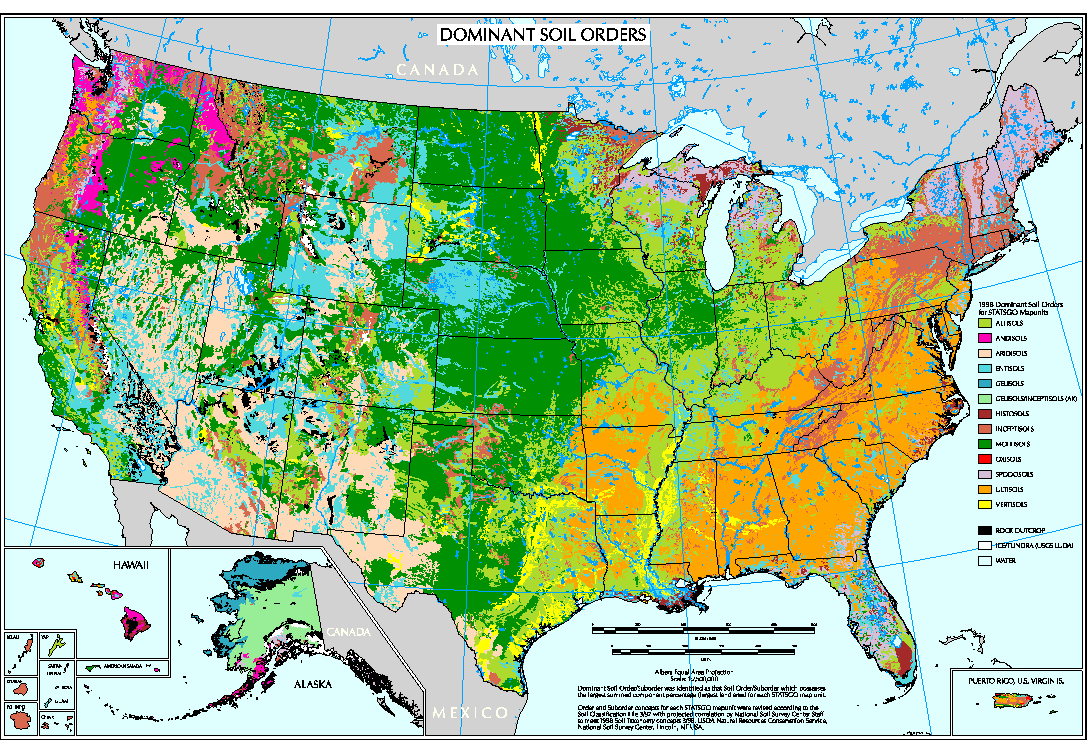
One of the most common practices for golfers is to compare the process of aerification at their course with that of their best friend, or better yet their course that they play in a different part of the country.  It was common to hear from a member what the course in Florida would do, interesting as it was, it was apples and oranges.  Soils are very different across numerous types of delineation boundaries.
Dominant Soils of the U.S.
 Not only are soils different north to south, east to west, but even on the same property.
I managed a course that glaciation had carved out a great lake, Lake Michigan.  The old Lake Michigan shoreline cut right across the property.  Nine holes was beautiful sandy loam soil and the other 18 was a terrible grey clay.  Our aerification philosophy was different for different holes on the same property!


The photo below is of an Aerification tine known as a hollow tine.  The hollow tine has a cut out which allows the soil to enter up and through the tine and eject onto the surface of whatever is being aerifyed. The above photo is a result of aerifying with a hollow tine.  The core is the soil and turf that is ejected out of the tine and deposited on the soil.  When hollow tine core aerification is done, the cores need to be cleaned up, either disposed of, or chopped up and incorporated into the playing surface.
The type of soil will dictate how much work and what type of process will follow core aerification.

Solid tines come in a variety of configurations.  The type of solid tine that is used is chosen for whatever the goal is.  A cross tine may be used for venting if the goal is to maximize surface area of soil that is to be exposed to air and if playability allows.  Solid tines come in a variety of sizes and the size that is used will be chosen to balance playability with the goals.
Goals of aerification, aside from making you the most popular employee at the club for two weeks, can range from amending the soil, organic matter control, improving root zone drainage, compaction relief, soil venting, disruption and correction of layering, soil composition improvement, improving the soil chemistry, interseeding and more.
Brooming sand after hollow tine
You see, since there are so many different reasons to aerify, no two courses may be trying to achieve the same result in a given year.  These playing surface are dynamic and needs change from year to year and even month to month.  Understanding why your Golf Course Superintendent aerifys a certain way, takes understanding your soils, structure, and turfgrass system, and the goals of such cultural practices to achieve the best playing surfaces possible.
Labor intensive work = not fun for anyone


The health of a turfgrass plant begins in the soil, it is the part of the system that the avid golfer do not see.  It is easy to dismiss aerification as an unnecessary disruption, however it is critical to the success of providing a quality playing surface that can withstand the stresses that are thrown at these systems.  The harder and more frequent the stress that we inflict on these systems, the more frequent and intense our cultural practices need to be.
So, don't worry, soon the playing surfaces will be healed, and the disruption will pay dividends.
Life is good,
Turf


Friday, August 12, 2016

Expansion of the "World of Turf"

Today is the end of one stage for me and the beginning of another. I end a career as COO and Director of Golf Operations, and enter into the world of providing service to my colleagues.
There are a flood of emotions through me, including sadness, excitement, and a little fear. Change is difficult, the golf course is all I know. It has been great to have the support of everyone around me encouraging me and insisting that I will be successful.
One of the things I am looking forward to, is more time with this blog. This blog will really become the "World of Turf" as I blog about all kinds of turf and golf courses and not just Briar Ridge. It is my hope that my sales visits will result in some great stories, photos, and information. I just hope that my colleagues will trust me enough to let me use them as topics.
The guys surrounding me are the ones I owe my success to, Marco Huerta, Flavio Huerta, David Rodriquiz, and Polo Huerta. These guys have been with me the entire time and had my back every time. There were also two special assistants, Dave Miloshoff and Andrew Reynolds. These two guys made me shine like a superstar.
I owe my success as a Golf Course Superintendent to my staff and the Golf Professional Staffs that I have worked with. Jack Sudac was a big supporter of mine and I will be forever grateful.
I would have never made it to Briar Ridge without Joe Williamson and Joel Purpur, thanks guys.
I look forward to the next chapter, and I hope you do too. This is just the beginning as we open the door to the "World of Turf."
Thanks to everyone at Briar, you are the best and will be missed......just ask Ralph,
Turf

Saturday, July 30, 2016

Happy first day of President's Cup

They say a picture is worth a thousand words, so check out the last photo, it explains the others. This is a tiny insight into some of the conversations we have at the club. The water had to be shut off to the bathrooms as the plumbing is behind the cinder-block wall. We will have to break out the wall to make the repair, so the bathrooms will be closed for a few days. We are very sorry for the inconvenience.
Good luck to all the Presidents Cup participants. Come check out the shootout Sunday afternoon around 2:30, it is a great event!
Vandalism makes Ralphie sad,
Turf

Tuesday, July 19, 2016

Dedos to the rescue?

The Dedos machine, shown below has been one of my favorite machines at Briar. I use it for a variety of situations.
We are running it today to try and help with our dry spots. The small slices it is putting in the turf will be treated with wetting agents and then hand watered in. As the photos show, these areas are still dry. The rain has not infiltrated into the hydrophobic areas.
With the humid weather and storms forecasted, we don't want to risk overwatering, therefore treating these areas with hand watering is again necessary.
There are many of these areas on each fairway.
War has been declared,
Turf