Tuesday, July 19, 2016

Dedos to the rescue?

The Dedos machine, shown below has been one of my favorite machines at Briar. I use it for a variety of situations.
We are running it today to try and help with our dry spots. The small slices it is putting in the turf will be treated with wetting agents and then hand watered in. As the photos show, these areas are still dry. The rain has not infiltrated into the hydrophobic areas.
With the humid weather and storms forecasted, we don't want to risk overwatering, therefore treating these areas with hand watering is again necessary.
There are many of these areas on each fairway.
War has been declared,
Turf

Friday, June 24, 2016

Would you rather?............

Is a fun game to play, and today I find myself asking if I would rather deal with "hot and dry" or "damp and muggy."  Since these two conditions are typical of our Northern Summers, these are the choices I provided for this game.  I have to say, "hot and dry" by far!  Now, I must clarify.  Dry is only tolerable if your irrigation coverage and output capabilities are adequate, if not, dry is no fun.  Our coverage and output is less than stellar, and typically hand watering replaces mowing.  We have discussed in the last couple of posts localized dry spots and how they also create the need for labor intensive hand watering.
Hand watering can also be necessary because as you can see in the photo, if we run the sprinkler to water the mound on the left, you would be hitting from soup on the right.  Irrigation is scheduled for adequate moisture in the majority of the playing surface and NOT the least common denominator.
The first photo also shows that the area affected by the dryness is relatively small in comparison to the entire fairway.  In the second photo, we zoom in on the area circled in the first photo.  Yuck, looks like a big dead spot, right?  In the third photo, we zoom in on the area in the second photo and reveal that with a little bit of moisture, we have begun to recuperate.  
Recuperation of these areas that were affected by moisture stress takes some time.  I constantly remind the staff to be careful when watering these areas.  The tendency is to expect them to turn green as you water them and thus drowning them and creating soggy areas that die and turn to dirt.  Educating the staff that these areas will take time to heal and that it is important to maintain the playability of these areas while nursing them back to health is a delicate balance.  "You can play off of brown, you can't play off of muck," is a phrase they have heard over and over again.  Encouraging them to be comfortable with the process and not expecting immediate results is a challenge.
I will explain why damp and muggy is not my choice when I return from battle with the dollar spot fungus which exploded overnight.
I would insert a clever hashtag to sign off with since my photos were edited with a popular social media app, but I really don't like hashtags.
I hope you have a marvelous day!
Turf


Sent from Erwin's phone, please excuse grammar and punctuation.

Tuesday, June 21, 2016

Localized dry spot and water-fearing soil

Golf Course Superintendents speak some strange language.  For instance, hydrophobic soils; really?  Yes, it is true, the soil can begin to repel water. 
My series of photos show a contrast of two soil samples taken side by side.  These two areas receive irrigation from the same irrigation heads.
When we find this type of situation, obviously we must hand water, but we also turn to other tools to help out.  Marco is shown watering these areas with a device on the hose that can contain a "pellet" of wetting agents.  Certain wetting agents help remove the organic acid coating on the soil particles which contribute to the hydrophobicity.  The pellet is much like a soap, helping water get into the soil by breaking water tension.  Some wetting agents are designed to help hold water in certain situations.  The array of products have become difficult to dissect, so the USGA and Michigan State University helped out with this research http://gsrpdf.lib.msu.edu/ticpdf.py?file=/article/zontek-understanding-7-20-12.pdf
With all of the science and experience supporting us, there is still no magic bullet.  Since each course has a unique soil structure and water chemistry, each Golf Course Superintendent is on his/her own to determine what works for the property they steward.
Have a great day, they are now getting shorter,
Turf


Sent from Erwin's phone, please excuse grammar and punctuation.

Wednesday, June 15, 2016

I will take "real rain" for $100 Alex....

The overnight and morning rain, sounded nice. It made the birds chirp louder, knocked down some of the dust off the patio furniture, but it didn't do a whole bunch to deficit of soil moisture.
The photo of the plug taken out of the ground shows very little moisture in the top portion of the plug. This time of year the roots are low and we want to punch the water down. The subsequent photos show just how dry that plug is, the soil crumbles into a dry powder. Superintendents often talk about thatch and controlling excessive amounts of thatch. The thatch in our fairways acts like a sponge and prevents water from moving down to the roots. Warm dry days with low humidity and light wind (like we have had), will pull moisture from the upper layers of thatch readily. Even though we have been watering, we can't put enough water down to move through the spongy thatch. The moisture we add overnight is simply pulled into the atmosphere during the day.
To try and manage these situations, we also utilize products called wetting agents or penetrants to reduce the water tension, and help the water down. Some guys will even take to strange customs like drawing turtles in the western-most bunker, but that's another post someday.
So, if you see us out hand watering today, we haven't gone crazy..........yet.
Turf

Friday, May 20, 2016

We Are Golf

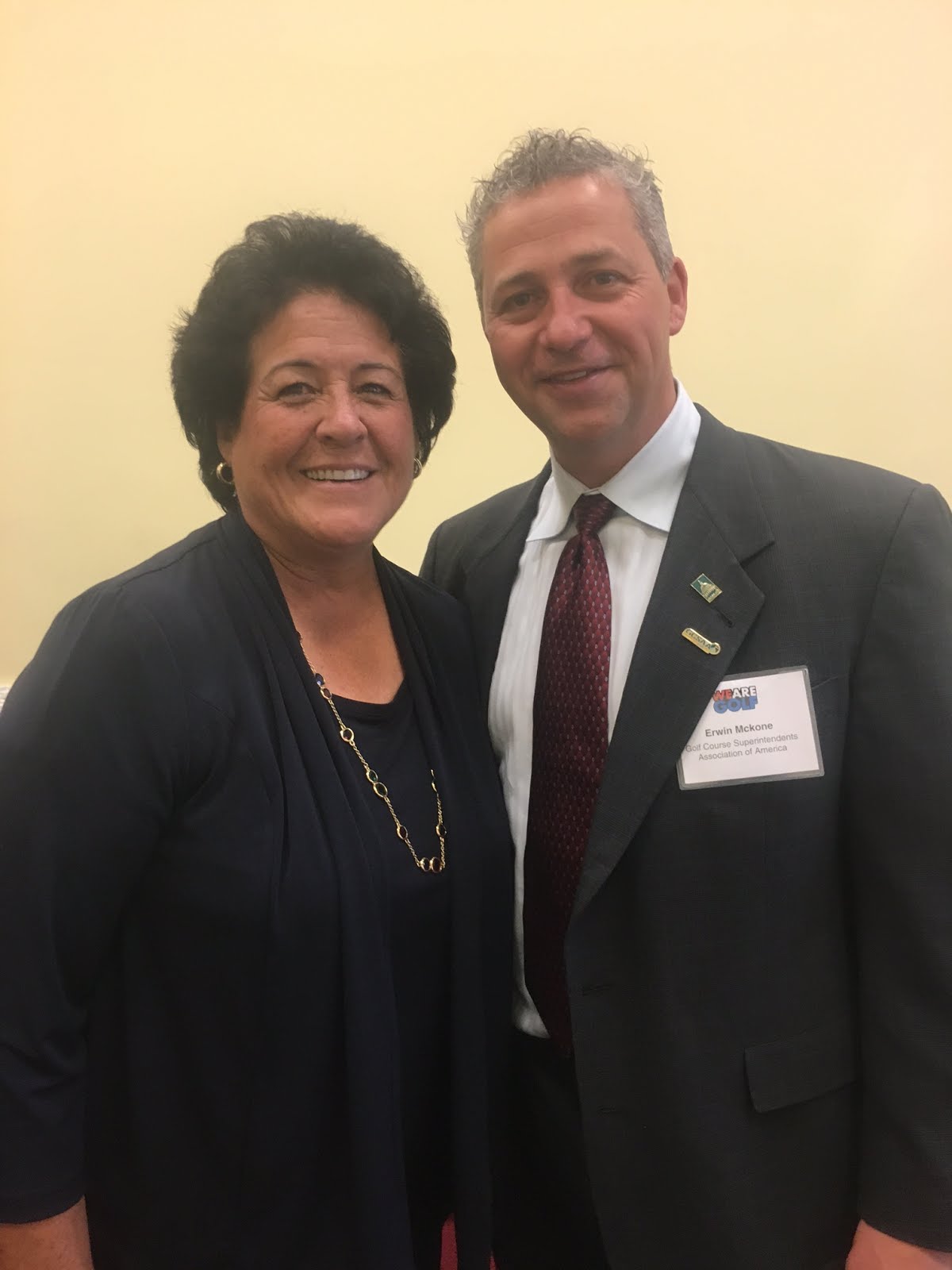
Wednesday, I met with Senators Joe Donnelly and Daniel Coats, and Congressman Peter Visclosky to discuss pending legislation and the impacts to the Golf Industry.  I was impressed at the attention and time we were given.  I was joined by Linda Rogers and Michelle Wittig, who represented the National Golf Course Owners Association.  
Before moving into the issues, we wanted to make sure congress understood the economic, charitable, environmental, and health and wellness aspects of golf.
Golf contributes $68.8 billion to the American economy.  One in 75 jobs is impacted by our industry.  Golf is bigger than spectator sports, performing arts, and the amusement and recreation industries.  In 2011, the National charitable impact of golf was $3.9 billion; which is more than MLB, NFL, NBA, and the NHL combined!
I have always been a fan of golf and the environment.  Golf is the only connection to nature for some.  Golf provides more than two million acres of green space to urban areas.
My favorite aspect of golf? The health benefits.  I love to walk nine holes.  As inactivity among Americans skyrockets, walking 18 holes is the equivalent of a 3.5 mile run or a 5 mile walk.
With all the wonderful things that golf provides, we are still a small business.  Regulations such as Overtime Pay Rule, and other issues such as H-2B Visa Delays, Waters of the United States rule, the Personal Health Investment Today (PHIT) Act, all impact our sustainability.  Thanks to all of our Allied Partners for showing up to support golf!
Visit http://wearegolf.org/, and see why people like Nancy Lopez feel compelled to join together on the Hill.
Special thanks to Briar Ridge for allowing me the time to promote our great sport!
Let's go golf,
Turf


Sent from Erwin's phone, please excuse grammar and punctuation.

Tuesday, May 10, 2016

Keeping you comfortable

Monday's are always a busy day for the course. This Monday was a busy day for the clubhouse. We installed two new rooftop units for the Willows. These two units were over 15 years old and had served the club well.
The club continues to improve, in many ways, and in many areas that go unnoticed. HVAC units are not real "fun" improvements, but very necessary. This summer as you enjoy the view outside the wall of windows in the Willows, the club hopes you are comfortable.
Please join us for Casino Night this Saturday!
Turf

Tuesday, May 3, 2016

Stump removal

We have begun to remove some of the stumps on the golf course. As you know, there are several areas on the course, riddled with stumps. The removal process is relatively quick. The subsequent removal or material, backfilling, and final preparations take a significant amount of time. We are excited that we have begun the process, please be patient with us as we go through the remaining steps.
Please be careful, as some of the areas will be cleaned of mulch and the hole will remain. We will have areas marked, however please pay attention when driving a cart in the rough. These areas do not require white paint until the chips are removed as they are covered under the provisions for material piled for removal.
Yea Free drop!
Turf